TLDR | Summary
Pressurized irrigation, commonly referred to as secondary water in Utah, is untreated water delivered through a dedicated irrigation system to supply sprinkler systems at a significantly lower cost than culinary water. Unlike drinking water, which must be purified, tested, and treated before reaching homes, secondary water is drawn directly from lakes, reservoirs, rivers, and canal systems and distributed specifically for landscape irrigation.
In Utah County and Salt Lake County, pressurized irrigation systems are standard infrastructure in many neighborhoods. These systems operate separately from culinary water lines and are designed exclusively for outdoor watering. Because the water is not treated to drinking standards, it is safe for lawns, gardens, and outdoor use but should never be consumed. Secondary water systems are seasonal. Most cities turn the system on around mid-April and shut it off around mid-October. If your sprinkler system runs in November or during the winter months, it is almost certainly connected to culinary water instead.
Understanding Secondary Water Systems
How Secondary Water Differs from Culinary Water
The primary difference between secondary and culinary water is treatment and purpose. Culinary water is purified for drinking, cooking, and indoor use. Secondary water is not purified and is intended strictly for irrigation. Because it bypasses the costly treatment process, it is significantly less expensive.
Another key distinction is seasonality. Culinary water is available year-round. Secondary water systems are turned on and off by municipalities or canal companies, meaning homeowners cannot irrigate during winter months. Finally, system components differ. Culinary irrigation systems require backflow prevention to protect drinking water supplies. Fully isolated secondary systems do not require backflow devices, though they do require high-quality filtration to manage debris in untreated water.
Where Does Secondary Water Come From?
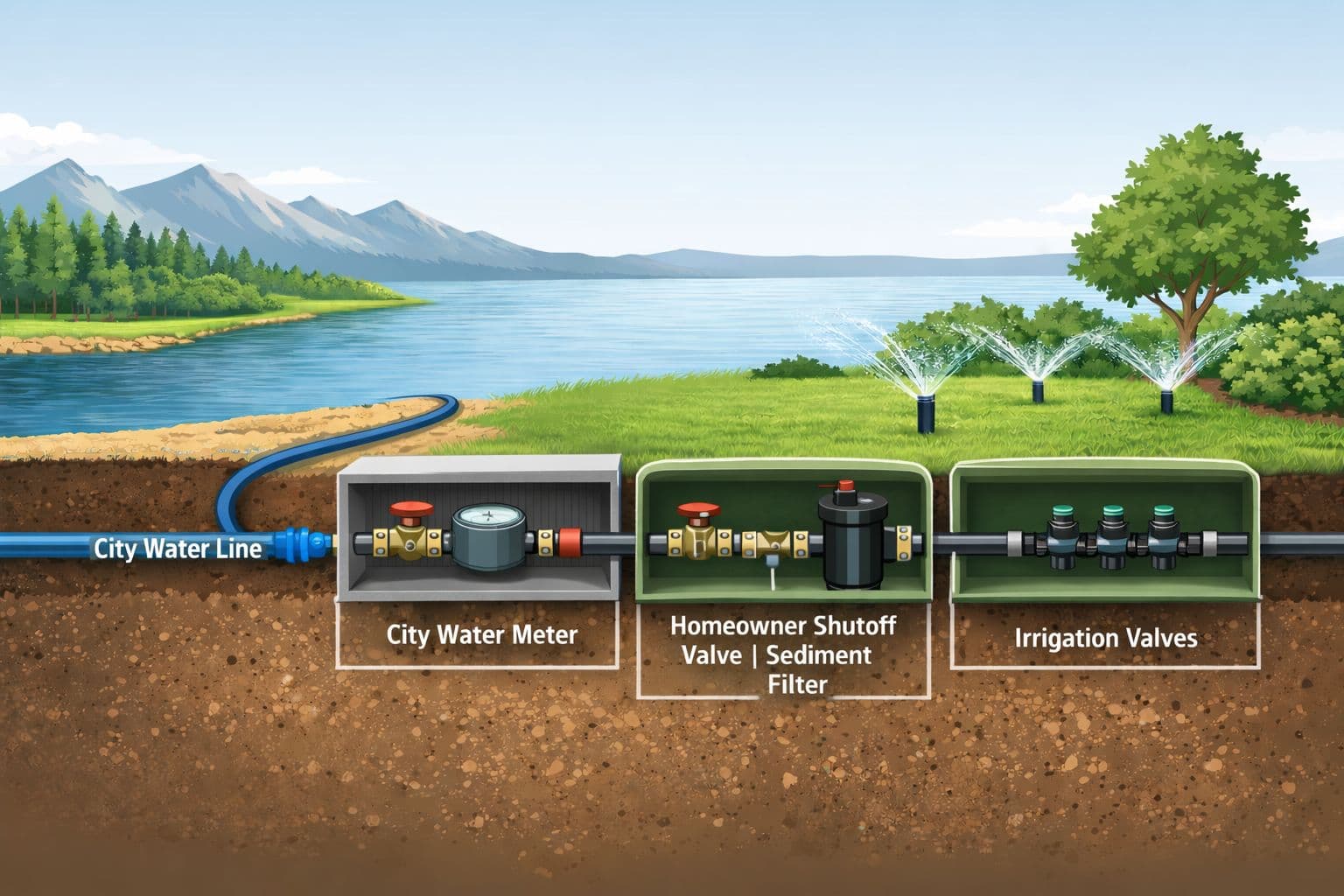
Pressurized irrigation water follows a predictable path:
Lake or reservoir → pump station → city water line → city water meter → homeowner shutoff valve → sediment filter → irrigation valves → sprinkler heads.
Secondary water in Utah County and Salt Lake County originates from lakes, rivers, reservoirs, and canal systems. Water is pumped through municipal infrastructure and delivered via dedicated irrigation lines that remain separate from drinking water systems. In many communities, canal companies help determine seasonal availability. Cities invest in pump stations and infrastructure upgrades to maintain pressure as neighborhoods expand. As demand increases, maintaining adequate pressure across growing areas remains a priority for local municipalities.
Benefits of Pressurized Irrigation in Utah
1. Lower Irrigation Costs
The most compelling reason homeowners switch to secondary water is cost. Because the water is not treated to drinking standards, it is typically two to five times cheaper than culinary water. Over a full Utah summer, this can translate into substantial savings, especially for properties with large lawns or extensive landscaping. For many households, the long-term savings offset the cost of connecting within just a few seasons. See our sprinkler system pricing guide for typical installation and conversion costs.
2. Environmental Responsibility
Using secondary water preserves treated drinking water for indoor use. Rather than applying purified water to grass, cities draw from designated irrigation sources that replenish naturally. This approach reduces strain on municipal treatment systems and supports responsible water management in Utah's dry climate.
3. Reduced Equipment Requirements
Culinary irrigation systems require backflow preventers, which are expensive and must be tested annually. Secondary systems that are fully isolated from drinking water do not require these devices. Eliminating backflow equipment reduces installation cost and long-term maintenance obligations. Learn more about sprinkler system installation and what your property needs.
Costs of Secondary Water
Cost to Connect to Secondary Water
Connecting to secondary water is usually straightforward, though the final cost depends on the existing system layout. If the project involves capping the old culinary connection and installing a sediment filter, costs typically range between $600 and $1,000. If a stop and waste valve must be removed, which requires additional excavation and plumbing adjustments, homeowners can expect costs between $1,750 and $3,000. If a backflow preventer is present on the culinary line, it should be removed during conversion. Removal generally costs between $200 and $500. In total, most conversions fall between $750 and $3,000 depending on complexity. Although permits are rarely required, a city inspection ensures proper isolation and code compliance. Professional contractors coordinate this inspection to guarantee safety and legality. For more information on how lawn irrigation contractors approach pricing in Utah, visit our comprehensive pricing guide to sprinkler systems.
Cost Per Gallon of Secondary Water
Secondary (pressurized irrigation) water pricing varies significantly across Utah County and southern Salt Lake County, but it is consistently much cheaper than culinary water. Some cities such as Bluffdale, Herriman, Salem, Santaquin, Springville, and Alpine use metered systems with per-1,000-gallon rates, often structured in conservation-based tiers that increase as usage rises. Other cities including Riverton, Highland, American Fork, and Pleasant Grove primarily charge flat monthly fees based on lot size, though several are transitioning toward metering in the coming years. In a few areas like Holladay, irrigation water is supplied by private ditch companies rather than the city. Overall, most homeowners pay somewhere between $20 and $50 per month for typical residential secondary water access, with higher costs tied to larger lots or heavy usage.
These are homeowner-friendly estimates for what most people pay during the irrigation season with normal usage. Actual bills vary based on lot size, watering habits, and city rate structures.
Seasonal Operation & Availability
Most cities activate pressurized irrigation around April 15 and shut it off around October 15, though exact dates vary slightly by municipality. After seasonal activation, many cities recommend waiting one to two weeks before running sprinklers to allow pressure to stabilize across the system.
Secondary water cannot be used year round. When the city shuts off supply in the fall, water is no longer delivered to your irrigation meter. However, water remains inside sprinkler lines, which is why winterization is still necessary. Use the tool below to determine the dates that your city turns irrigation water on and off.
Find Your Sprinkler Season Dates
Select your city to see when sprinklers typically turn on and off.
Filtration for Pressurized Irrigation Systems in Utah
Because secondary water is untreated, it naturally contains sediment, algae, and organic debris that can quickly clog valves and sprinkler nozzles if it is not properly filtered. For this reason, a high-quality filter is one of the most important components in any pressurized irrigation system. The filter should be installed immediately after the homeowner shutoff valve and before the irrigation valves so it protects the entire downstream system. Most residential systems in Utah use durable mesh-style Y filters, which are reliable and relatively easy to clean. Mesh ratings such as 30, 50, and 120 indicate how fine the filtration is, with higher mesh numbers capturing smaller particles but requiring more frequent cleaning. During peak irrigation months, filters should be cleaned monthly and at minimum twice per season, as a clogged filter commonly causes noticeable pressure drops across every zone.
It is also important to understand what is normal with secondary water. A mild lake-like smell is expected, and brownish green residue inside pipes or filters is common. However, the water spraying from sprinkler heads should appear clear. If you see discolored water coming out of your sprinklers, that is not typical and the system should be inspected to prevent long-term damage or uneven coverage. Our favorite type of filter is manufactured by a company called Amiad, and works great because of its removable mesh filters.
It is also important to clean your pressurized irrigation filter regularly. We do this by turning off the water, removing the filter, scrubbing it with a wire brush, rinsing with a hose or other water source, and returning the mesh into the filter body. Once it is sealed shut, we turn the water back on and let it run! Try to clean your filter regularly to prevent weak spray and valve sticking.
Need a filter installed on your property? Visit our Utah lawn sprinkler repair page for any additions and modifications to existing sprinkler systems.
Conclusion
A well-designed pressurized irrigation system must account for debris in untreated water and occasional pressure fluctuations throughout the season. Zones are typically built slightly smaller than culinary systems to ensure consistent coverage during peak demand, and nozzle selection plays a major role in long-term reliability. Larger orifice nozzles and impact-style rotor heads tend to perform better in secondary water environments because they allow small particles to pass through more easily, reducing clogging and uneven spray patterns. Systems that are thoughtfully designed from the beginning require less maintenance and protect valves, sprinkler heads, and main lines from premature failure.
Most secondary water problems trace back to filtration or maintenance. Low pressure is often caused by a clogged filter, early-season city pressure stabilization, or a hidden mainline leak. Irregular spray patterns usually result from debris in nozzles, and valves that fail to shut off often have sediment lodged inside. Regular inspection and filter cleaning prevent the majority of these issues. Even though cities shut off pressurized irrigation in the fall, professional winterization is still essential because water remains trapped inside pipes and components. A proper blowout protects your system from freeze damage and ensures everything is ready when water returns in the spring.
If you are considering converting from culinary to secondary water, proper isolation, backflow removal, and professional installation are critical to keeping drinking water protected and ensuring your irrigation system operates safely and efficiently. For many homeowners in Utah County and Salt Lake County, secondary water significantly reduces long-term irrigation costs, especially on larger properties, but the financial benefits depend on your lot size, current water bills, and local rate structure.
Pressurized irrigation systems are a proven and cost-effective solution for Utah landscapes when they are properly filtered, thoughtfully designed, and professionally maintained. If you would like to know how your current sprinkler system could be improved, optimized for secondary water, or converted safely and efficiently, we recommend booking a consultation. We can evaluate your layout, pressure, filtration, and component selection and provide clear recommendations to help your system run more reliably and efficiently for years to come.
About the Author
Austin Green is the founder and owner of Storm Sprinklers, an irrigation system repair and installation company based in Orem, UT. With 4 years of experience in the business of irrigation, he has learned the ins and outs of the technical side of lawn sprinkler systems as well as the economics of water efficiency. Austin knows what Utah homeowners are looking for in their lawn sprinkler systems, and writes guides to help them get what they need.